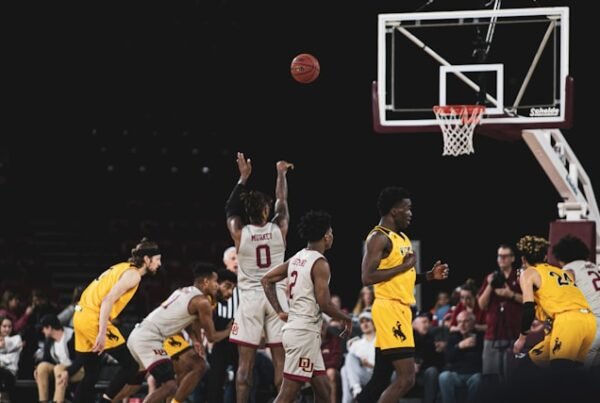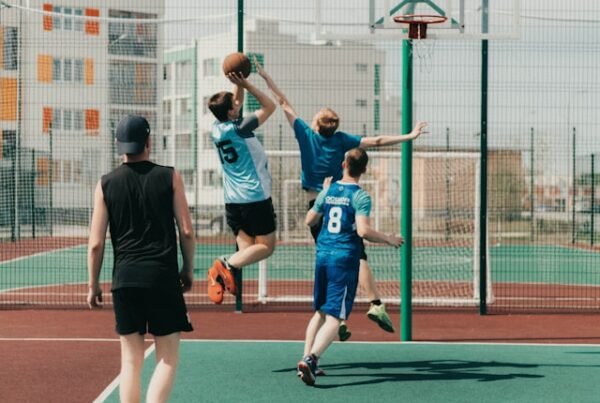
Every youth coach meets the same parent eventually. Their child is eleven, talented, and already playing basketball four times a week, eleven months a year. They want to know whether that is enough — or whether it should be five.
It is a reasonable question asked from the wrong end. The issue with early specialisation is rarely the number of sessions. It is what a single-sport calendar removes from a developing athlete, and how little of that can be recovered later.
What specialisation actually costs
A player who only ever plays basketball develops a narrow movement vocabulary. They become excellent at the specific patterns of the game — lateral slides, jump-stop landings, one particular shooting motion — and comparatively poor at everything adjacent to it. That narrowness shows up in three places.
Movement range
Athletes who play several sports before adolescence arrive at serious basketball training with more ways to solve a physical problem. They rotate better, land better, decelerate better. These are not basketball skills, but they are the foundation basketball skills are built on, and they are far easier to acquire at eleven than at seventeen.
Load variety
The same sport, on the same surface, in the same movement patterns, week after week, concentrates stress in the same tissues. Volume is not the enemy — monotony is. A player doing a similar weekly load across two or three activities is loading the body far more evenly than one repeating the identical stimulus.
Decision-making
Other sports pose problems basketball does not. A player who has had to read a different game, at a different tempo, with different spacing rules, brings a broader sense of what to look for. Coaches often describe this as “seeing the floor” — much of it is simply having solved more kinds of problem.
The identification trap
Early specialisation is often justified by early results, and early results are the least reliable signal in youth sport. At twelve, the biggest advantage on most courts is maturation, not ability. The early-maturing player dominates, is selected, receives more coaching and more minutes, and improves further — while the late developer, who may have the better long-term profile, drifts out of the selection funnel entirely.
This is the single most common way clubs lose players they should have kept. Selecting for present performance and calling it talent identification is a structural error, not a coaching one.
What to do instead
-
- Protect one season a year for something else. Not rest — a different sport, with different demands.
- Vary the training stimulus deliberately. Different surfaces, different work-to-rest ratios, different constraints in small-sided games.
- Record maturation, not just performance. Height, growth rate and relative age put a twelve-year-old’s numbers in context.
- Judge learning rate, not standing. How quickly does a player absorb a correction? That travels; a current advantage in size does not.
- Be honest with parents. Most specialisation pressure comes from a genuine fear of falling behind. It is answerable with evidence, not reassurance.
The real question
Ask not whether a player is training enough, but whether they will still be playing at eighteen — physically intact, still improving, and still enjoying it. Judged that way, the four-times-a-week eleven-year-old is not obviously ahead of anyone.
Prof. R. Paulauskas covers this in depth in Early specialisation in basketball and Talent identification, both part of the Basketball Training Theory Course at IBU University.